
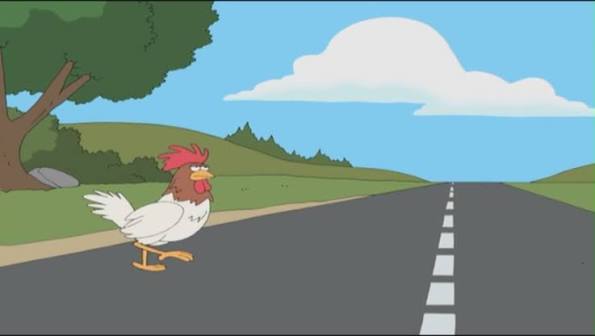
Readers treat query as humor built on an anti-humor punchline subverting expectation. Historians unpack why formulation endures across culture.
question works by delivering flat answer. People query smart answers because riddle serves as touchstone for problem-solving across disciplines.
Thinkers utilize premise explore quantum mechanics alongside corporate philosophies.
Why Did the Chicken Cross the Road?
Flexibility keeps joke fresh inside digital search indexes. Theoretical fields turn schoolyard joke into playground for thought. Einstein might declare that transit depends on reference frames.
Newton would note chickens at rest stay put while motion continues. Descartes would determine bird thought, so it crossed. Disciplines tackle transit differently.
Philosophical takes break down into distinct perspectives across schools.
- Quantum physics states chicken occupied both sides until someone observed it.
- Corporate management frames relocation as strategic pivot toward new growth markets.
riddle shifts when tied local history rather than abstract philosophy. Records show early rural towns in 19th-century America frequently had wandering poultry on dirt routes. Farmers erected fences keep animals from crop rows. bird sought better forage on opposite shoulder. Practicality vanishes once philosophers debate existential motives. A farm bird moving across asphalt encounters moving vehicles alongside tire traction limits.
Hauling live animal busy state highway test crossing ideas carries different weight from desk theorizing. Physical reality makes road trips dangerous for livestock.
Examining the rest of the town's historical poultry customs reveals why those early dirt paths mattered. Generations of children and adults have repeated joke as a staple of American humor. People continue search for the origin of the joke because it remains one of oldest and most widely recognized riddles in the English language. Folklore researchers have tracked similar cross-the-road queries in nineteenth-century publications across United States.
Writers often used format as simple piece of filler text between longer columns of news. The bird simply walked to the other side. That pedestrian interpretation strips away any hidden meaning or philosophical depth. Listeners wait for clever pun, but the question contains its own literal answer. Folklorists point out that mid-nineteenth-century parlor games frequently relied on anti-jokes.
Instead of connecting two unrelated things, question treated physical movement of farm animal as the entire event. Print historians have documented several early variations of the joke in regional publications.
- 1892 New York publication used exact phrasing familiar modern readers.
- An 1847 issue of London literary magazine featured distant cousin about duck crossing an alley.
- American newspapers picked up the chicken version during late 1890s and syndicated it nationally.
Writers often attribute deep symbolic weight the query, but historical evidence suggests no grand design. The originators likely invented the line on whim to fill empty space on printed page.
- An anonymous editor drafts short riddle for local periodical.
- Readers repeat the question in casual conversation across town.
- Other publishers copy the text into regional newspapers and school yearbooks.
- phrase cements its place in American popular culture as universal shorthand for pointless inquiry.
Urban legends sometimes attach specific farm or named farmer the first crossing, but archives contain no such attribution.
Every new variation acknowledges the original setup. foundational premise stays intact while punchline bends fit era. The query survives because it requires no specialized knowledge to understand.
Anyone who has ever watched farm animals wander near rural fence line recognizes mundane reality of the scene. road is simply pavement. chicken is simply walking.




Comments 0
No comments yet. Start the conversation.